Concatenating neural datasets in deepSTRF

deepSTRF lets you concatenate two or more NeuralDataset instances along both the stim and neuron axes, producing a single chimeric dataset that pools recordings from different sources. This notebook walks through the feature on CRCNS AA1 + AA2 — same species (zebra finch), similar experimental preparations, but disjoint cohorts and stimulus sets.
For the design rationale and the full API, see `dataset_concatenation.md <../docs/_source/md/dataset_concatenation.md>`__ and `data_paradigm.md <../docs/_source/md/data_paradigm.md>`__.
Two worked examples below: the single-species AA1 + AA2 case (most of the notebook), and a cross-species AA1 + NS1 chimera (ferret A1 + zebra finch Field L / MLd) at the end as the most distinctive use case.
Setup — Google Colab
If you’re running on Google Colab, the cell below installs deepSTRF from source. On a local install (pip install -e .) it’s a no-op.
Note on data: AA1 and AA2 are authenticated CRCNS datasets. To auto-download them, set $CRCNS_USERNAME and $CRCNS_PASSWORD (free account at https://crcns.org/) before running the dataset cells. NS1 is fetched from OSF — no credentials needed. On a local machine that already has the data extracted, it’s picked up from the cache automatically.
[ ]:
import sys
if 'google.colab' in sys.modules:
    !pip install -q git+https://github.com/urancon/deepSTRF.git
    print("deepSTRF installed from GitHub.")
else:
    print("Local environment — assuming deepSTRF is already importable.")
Imports
[ ]:
%matplotlib inline
import matplotlib.pyplot as plt
import torch
from torch.utils.data import DataLoader

from deepSTRF.datasets.audio.crcns_aa1 import CRCNSAA1Dataset
from deepSTRF.datasets.audio.crcns_aa2 import CRCNSAA2Dataset
from deepSTRF.utils.data import concat_neural_datasets, neural_collate

DT_MS = 5
1. Load the two source datasets
Both must share dt_ms and n_mels (audio’s F). deepSTRF will assert on a mismatch — see the Compatibility section below.
[ ]:
aa1 = CRCNSAA1Dataset(download=True, dt_ms=DT_MS)
aa2 = CRCNSAA2Dataset(download=True, dt_ms=DT_MS, smooth=False)

print(f"aa1: {aa1}")
print(f"aa2: {aa2}")
print(f"both have F = {aa1.F} mel-bands and dt = {aa1.dt} ms — concatenable.")
2. Concatenate
Two equivalent forms:
[3]:
combined = concat_neural_datasets([aa1, aa2])
combined_alt = aa1 + aa2     # pairwise __add__ sugar; identical result

assert combined.N_neurons == combined_alt.N_neurons
assert combined.get_S() == combined_alt.get_S()

print(f"combined: {combined}")
print(f"  type     : {type(combined).__name__}   "
      f"# most-specific common ancestor (AA1 + AA2 -> AudioNeuralDataset)")
print(f"  N        : {aa1.N_neurons} + {aa2.N_neurons} = {combined.N_neurons}")
print(f"  S        : {aa1.get_S()} + {aa2.get_S()} = {combined.get_S()}")
combined: AudioNeuralDataset(N_neurons=594, selected=0, N_stims=147, dt_ms=5)
  type     : AudioNeuralDataset   # most-specific common ancestor (AA1 + AA2 -> AudioNeuralDataset)
  N        : 100 + 494 = 594
  S        : 30 + 117 = 147
3. The block-diagonal nrn_masks
Concatenation places each source dataset in its own (S_i, N_i) block on the diagonal. The cross-blocks — stims from one source paired with neurons from another — are filled with the canonical (1, 1) NaN sentinel, so deepSTRF’s existing missingness machinery (the nrn_masks property derived on the fly from responses) handles them automatically.
The total number of “real data” pairs in the combined mask should equal the sum of valid pairs in the sources — no double-counting, no leak across the diagonal.
[4]:
expected = int(aa1.nrn_masks.sum()) + int(aa2.nrn_masks.sum())
got = int(combined.nrn_masks.sum())
print(f"valid (stim, neuron) pairs in aa1: {int(aa1.nrn_masks.sum())}")
print(f"valid (stim, neuron) pairs in aa2: {int(aa2.nrn_masks.sum())}")
print(f"sum                              : {expected}")
print(f"valid pairs in combined          : {got}    "
      f"(matches: {got == expected})")
valid (stim, neuron) pairs in aa1: 2960
valid (stim, neuron) pairs in aa2: 18902
sum                              : 21862
valid pairs in combined          : 21862    (matches: True)
[5]:
fig, ax = plt.subplots(figsize=(11, 4))
ax.imshow(combined.nrn_masks.T.numpy(), aspect="auto", cmap="Greys",
          interpolation="nearest")
ax.axhline(aa1.N_neurons - 0.5, color="tab:red", lw=1, ls="--",
           label="neuron block boundary")
ax.axvline(aa1.get_S() - 0.5,  color="tab:red", lw=1, ls="--",
           label="stim block boundary")
ax.set_xlabel("Stimulus index (AA1 stims | AA2 stims)")
ax.set_ylabel("Neuron index (AA1 neurons | AA2 neurons)")
ax.set_title(f"`combined.nrn_masks` — black = real (stim, neuron) data; "
             f"empty quadrants are NaN sentinels")
ax.legend(loc="upper right")
plt.tight_layout()
plt.show()
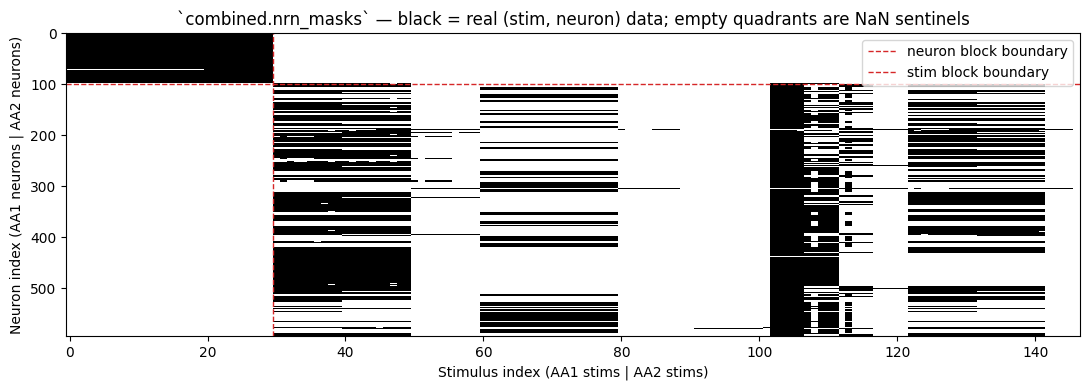
The two black quadrants are the AA1 and AA2 source blocks (preserving each dataset’s intra-source coverage pattern). The two empty quadrants are the cross-blocks — where AA1 neurons are paired with AA2 stims and vice versa, with NaN sentinels filling those entries.
4. Metadata flows through
Each source’s stim_meta and nrn_meta are concatenated in the same order as the data, so combined.nrn_meta[42] still returns AA1’s 42nd neuron’s dict, and combined.nrn_meta[120] returns AA2’s 20th (after the 100 AA1 neurons).
This means the neuron-selection helpers continue to work with no adaptation:
[6]:
# select all MLd neurons in the combined dataset — picks them up from
# BOTH sources (AA1 and AA2 both happen to use the "MLd"/"mld" label).
combined.select_pop_by_nrn_attr("area", "MLd")
print(f"MLd neurons selected from combined: {len(combined.I)}")

# AA2 uses lowercase 'mld' for its area label; we can union both:
mld_indices = [
    n for n, meta in enumerate(combined.nrn_meta)
    if meta["area"].lower() == "mld"
]
combined.select_population(mld_indices)
print(f"MLd-or-mld neurons (case-insensitive): {len(combined.I)} "
      f"({100 * len(combined.I) / combined.N_neurons:.1f}% of pooled population)")
MLd neurons selected from combined: 50
MLd-or-mld neurons (case-insensitive): 193 (32.5% of pooled population)
4.5 Iteration follows the selection
This is where chimeric datasets really earn their keep. len(combined) and combined[i] are both filtered by the current neuron selection — they only expose stimuli for which at least one selected neuron has valid response data. Selecting one source’s neurons therefore hides the other source’s stimuli from iteration entirely, with no extra bookkeeping in the training loop.
(See `data_paradigm.md <../docs/_source/md/data_paradigm.md>`__ §8 for the general rule across all NeuralDataset instances. The chimeric case is just a particularly clean illustration.)
[7]:
# default: every neuron selected -> every stim is iterable.
combined.select_population(list(range(combined.N_neurons)))
print(f"all neurons:        len(combined) = {len(combined):>3}    "
      f"(expect {aa1.get_S()} + {aa2.get_S()} = {aa1.get_S() + aa2.get_S()})")

# select only AA1's neurons -> AA2's stims disappear.
combined.select_population(list(range(aa1.N_neurons)))
print(f"only AA1's neurons: len(combined) = {len(combined):>3}    "
      f"(expect {aa1.get_S()})")
print(f"  combined[0] stim_meta  = {combined[0][3]}")
print(f"  combined[-1] stim_meta = {combined[-1][3]}    # last iterable")
try:
    combined[aa1.get_S()]
except IndexError as e:
    print(f"  combined[{aa1.get_S()}] raises IndexError — AA2 stim is hidden, not silently NaN")

# select only AA2's neurons -> AA1's stims disappear.
combined.select_population(list(range(aa1.N_neurons, combined.N_neurons)))
print(f"only AA2's neurons: len(combined) = {len(combined):>3}    "
      f"(expect {aa2.get_S()})")
print(f"  combined[0] stim_meta  = {combined[0][3]}    # first iterable is AA2's first stim")
all neurons:        len(combined) = 147    (expect 30 + 117 = 147)
only AA1's neurons: len(combined) =  30    (expect 30)
  combined[0] stim_meta  = {'name': '058767E725C83836F405A97FD7D1E751.wav', 'type': 'conspecific', 'sample_rate': 32000.0, 'n_samples': 62144, 'duration_s': 1.942}
  combined[-1] stim_meta = {'name': 'FDD2F383A22BCFA000DEBD48FAC0ADF0.wav', 'type': 'flatrip', 'sample_rate': 32000.0, 'n_samples': 64000, 'duration_s': 2.0}    # last iterable
  combined[30] raises IndexError — AA2 stim is hidden, not silently NaN
only AA2's neurons: len(combined) = 117    (expect 117)
  combined[0] stim_meta  = {'name': 'D54ABC42488F995C789F351A34316039.wav', 'type': 'conspecific', 'sample_rate': 32000.0, 'n_samples': 55105, 'duration_s': 1.72203125}    # first iterable is AA2's first stim
The training loop for a chimeric model that’s only being supervised on AA1’s neurons therefore sees only AA1’s stims — automatic. Same for AA2. Use select_pop_by_nrn_attr to slice on metadata fields (e.g. “all MLd neurons across both sources”), and the iterable space adapts just as cleanly.
5. Iterating with DataLoader
The combined dataset is just a NeuralDataset, so neural_collate batches it the same way it batches any single source. The valid_mask returned by the collate already reflects the block-diagonal structure of the cross-blocks — your loss code does not need any adaptation.
[8]:
combined.select_population(list(range(min(combined.N_neurons, 32))))  # take 32 neurons for a small batch demo
loader = DataLoader(combined, batch_size=4, shuffle=False, collate_fn=neural_collate)

batch = next(iter(loader))
stims, responses, valid_mask, stim_metas = batch['stims'], batch['responses'], batch['valid_mask'], batch['stim_meta']
print(f"stims shape       : {tuple(stims.shape)}")
print(f"responses shape   : {tuple(responses.shape)}")
print(f"valid_mask shape  : {tuple(valid_mask.shape)}    (B, N, R, T)")
print()
print(f"valid fraction in batch : {valid_mask.float().mean().item():.3f}")
print(f"stim_metas              : {stim_metas}")
stims shape       : (4, 1, 32, 460)
responses shape   : (4, 32, 15, 460)
valid_mask shape  : (4, 32, 15, 460)    (B, N, R, T)

valid fraction in batch : 0.576
stim_metas              : [{'name': '058767E725C83836F405A97FD7D1E751.wav', 'type': 'conspecific', 'sample_rate': 32000.0, 'n_samples': 62144, 'duration_s': 1.942}, {'name': '0A07B255BF830083B6726388CA8510BA.wav', 'type': 'conspecific', 'sample_rate': 32000.0, 'n_samples': 73557, 'duration_s': 2.29865625}, {'name': '1470489635DD93410408CE9F8FB2F7D9.wav', 'type': 'conspecific', 'sample_rate': 32000.0, 'n_samples': 69890, 'duration_s': 2.1840625}, {'name': '42FED9F3EF45A238202B050B06F91652.wav', 'type': 'conspecific', 'sample_rate': 32000.0, 'n_samples': 52761, 'duration_s': 1.64878125}]
6. What deepSTRF refuses to concatenate
deepSTRF rejects mismatches that would silently produce wrong results. You’d see an AssertionError from the relevant _concat_check_compat hook. A couple of examples:
[ ]:
# dt mismatch -> rejected
aa2_finer_bin = CRCNSAA2Dataset(download=True, dt_ms=1, smooth=False)
try:
    combined = aa1 + aa2_finer_bin    # aa1 is dt=5, aa2_finer_bin is dt=1
except AssertionError as e:
    print(f"AssertionError (expected): {e}")
[ ]:
# F mismatch -> rejected
aa2_more_mels = CRCNSAA2Dataset(download=True, dt_ms=DT_MS, n_mels=64, smooth=False)
try:
    combined = aa1 + aa2_more_mels    # aa1 has F=32, aa2_more_mels has F=64
except AssertionError as e:
    print(f"AssertionError (expected): {e}")
7. Across species: pooling AA1 (zebra finch) + NS1 (ferret)
The block-diagonal layout shines when sources come from different species, labs, or stimulus banks. Since aa1 and ns1 have totally disjoint stim sets, neurons, and recording protocols, every cross-block entry is a (1, 1) NaN sentinel — there’s no risk of accidental aliasing — and the resulting chimeric dataset is something a single model can be fit to via the area-filtered selection.
The only real requirement for cross-species concat: matching dt_ms and n_mels. NS1’s stimulus tensor is precomputed at dt=5ms, F=34, so we load AA1 with the same parameters here.
[ ]:
from deepSTRF.datasets.audio.ns1 import NS1Dataset

ns1 = NS1Dataset(download=True, dt_ms=5)          # ferret A1, 119 neurons, 20 nat stims
aa1_34 = CRCNSAA1Dataset(download=True, dt_ms=5,
                           n_mels=34)              # match NS1's F=34
chimera = ns1 + aa1_34
print(chimera)
print(f"  area=A1     -> {len(chimera.select_pop_by_nrn_attr('area', 'A1'))} ferret neurons")
chimera.I = []
print(f"  area=Field_L -> {len(chimera.select_pop_by_nrn_attr('area', 'Field_L'))} zebra-finch neurons")
chimera.I = []
print(f"  area=MLd     -> {len(chimera.select_pop_by_nrn_attr('area', 'MLd'))} zebra-finch neurons")

# block-diagonal mask: NS1 covers stims 0..19 / neurons 0..118; AA1 covers stims 20..49 / neurons 119..218
fig, ax = plt.subplots(figsize=(11, 4))
ax.imshow(chimera.nrn_masks.T.numpy(), aspect='auto', cmap='gray_r', interpolation='nearest')
ax.axhline(ns1.N_neurons - 0.5, color='red', linestyle='--', linewidth=1)
ax.axvline(ns1.get_S() - 0.5,    color='red', linestyle='--', linewidth=1)
ax.set_xlabel('stim index')
ax.set_ylabel('neuron index')
ax.set_title('NS1 (ferret A1) + AA1 (zebra finch Field_L/MLd) — block-diagonal coverage')
plt.tight_layout()
plt.show()
Recap
concat_neural_datasets([a, b, ...])(ora + b) returns a singleNeuralDatasetwhose stim and neuron axes are the unions of the inputs’, with cross-block entries filled by NaN sentinels.The result’s
nrn_masksderives the block-diagonal coverage automatically from those sentinels — no extra bookkeeping.The combined dataset is a drop-in replacement for any of its source datasets in
DataLoader,neural_collate,select_*, etc.deepSTRF rejects
dt_msandF(or(H, W)) mismatches at concat time — no silent resampling.
Cross-species concatenation example (AA1 + NS1) will land here once NS1 is modernized to the new base API.